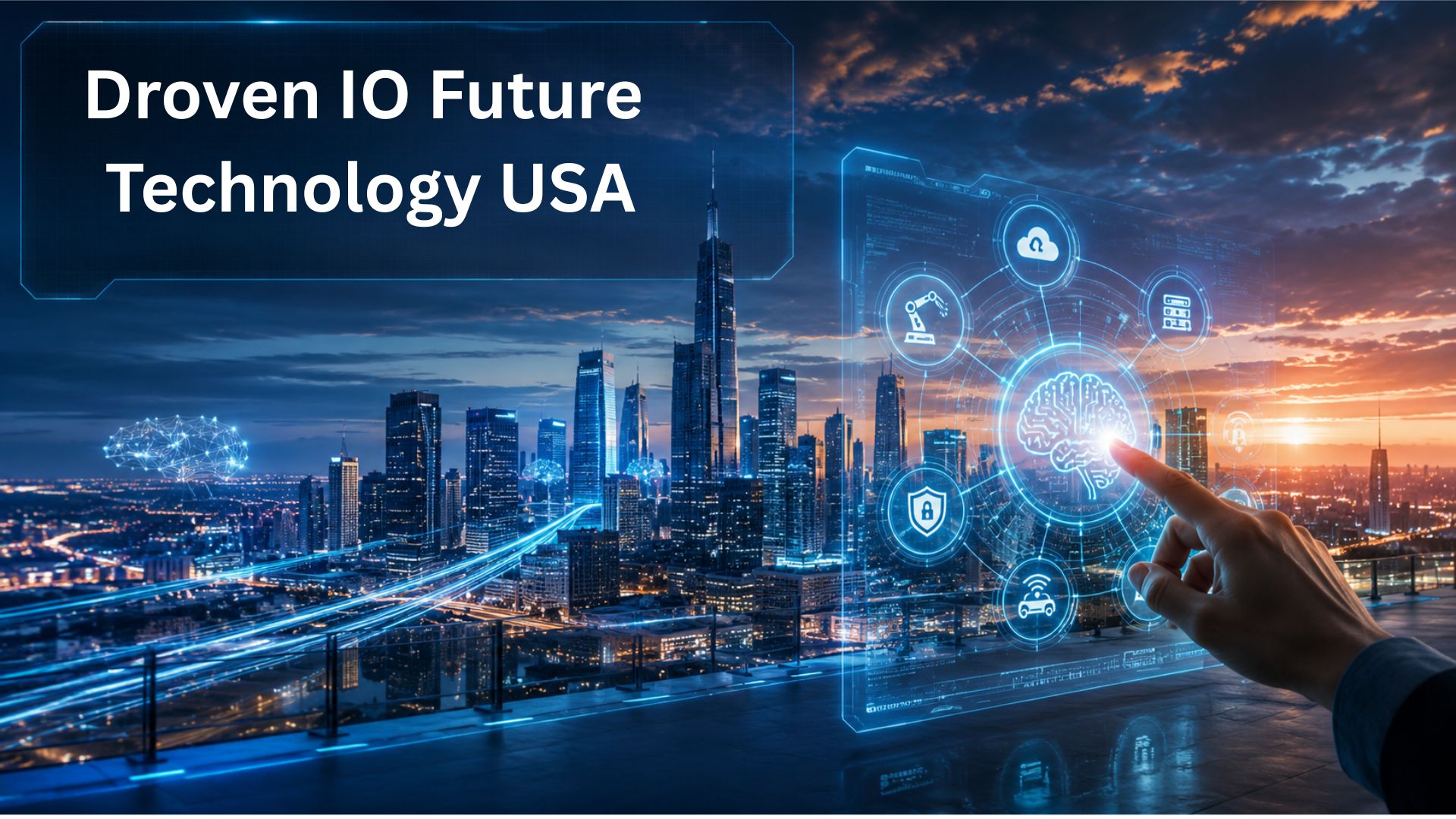
Technology does not pause, and in 2026, that truth is more visible than ever. Across the United States, industries are being reshaped by intelligent systems, automated workflows, cloud-driven infrastructure, and a generation of tools that were considered futuristic just a few years ago. At the center of growing conversations about this shift is a term that has been gaining meaningful traction online: Droven IO Future Technology USA. Whether you are a business owner, a student entering the tech workforce, or a professional trying to stay relevant, understanding what this phrase represents can help you make smarter decisions in a fast-evolving digital economy. This article breaks down the full picture clearly, accurately, and with a practical context you can act on.
Contents
- 1 What Is Droven IO and Why Is It Gaining Attention in the USA
- 2 The Core Technology Areas Droven IO Covers for the American Market
- 3 How AI and Machine Learning Are Transforming US Industries Right Now
- 4 Cloud Computing and Edge Infrastructure as the Backbone of Digital America
- 5 Cybersecurity in the Age of AI-Powered Threats
- 6 Robotics, Automation, and the Future of American Work
- 7 Quantum Computing and Next-Generation Technologies on the Horizon
- 8 Career Opportunities in the US Tech Landscape for 2026 and Beyond
- 9 Digital Twins, IoT, and the Intelligence Behind American Infrastructure
- 10 Why Droven IO Future Technology USA Matters for Businesses and Learners Today
What Is Droven IO and Why Is It Gaining Attention in the USA
Droven.io is best understood as an editorially independent knowledge platform built around artificial intelligence, automation, cloud computing, cybersecurity, and machine learning. Unlike a software product or SaaS tool, it does not sell subscriptions or push affiliate services. Instead, it functions as a structured resource hub that explains complex emerging technology in plain, accessible language. The platform is designed for a wide audience, including business owners exploring AI adoption, students learning future-ready digital skills, developers staying current with cloud infrastructure trends, and professionals navigating a rapidly changing job market.
The name itself carries purpose. “Droven” draws from an older regional English usage, an informal past form of “drive,” chosen deliberately by the platform’s founders to reflect the idea of being driven by genuine curiosity and a commitment to democratizing technology knowledge. In the context of the United States, where digital transformation is accelerating across every major industry, the need for trusted, unbiased educational content around AI and automation has never been greater. Droven.io fills that gap, and that is precisely why searches combining the platform with “future technology USA” have been rising steadily through 2025 and into 2026.
What sets Droven.io apart in a crowded online landscape is its independence. Most technology publications today have something to sell hiding beneath their content, whether that is a software product, a sponsored placement, or a vendor referral. Droven.io’s editorial model is built on a different foundation. Its value to readers comes entirely from the accuracy and depth of its content, not from commercial partnerships. That distinction matters significantly in an era when misinformation about AI is widespread, and businesses are making real investment decisions based on what they read online.
The Core Technology Areas Droven IO Covers for the American Market
The Droven IO Future Technology USA framework centers on a connected set of technologies that are actively reshaping how American industries operate. Artificial intelligence sits at the core of this ecosystem. AI is no longer a single technology but a layered infrastructure that includes generative models, autonomous agents, predictive analytics systems, and machine learning frameworks. According to PitchBook and OECD data, AI and machine learning ventures captured approximately 65% of all US venture capital deal value in 2025, a striking indicator of how deeply the American innovation economy has committed to AI-centered development.
Cloud computing forms the backbone through which most of these AI systems are deployed and scaled. Cloud infrastructure enables companies of any size to access computing power that was once limited to large enterprises with massive internal IT budgets. Droven.io explains cloud deployment models, SaaS platforms, hybrid infrastructure strategies, and the migration patterns that businesses across the US are actively navigating. Alongside cloud systems, cybersecurity has grown from an IT department concern into a core business survival requirement. With every connected system representing a potential entry point for threats, AI-based threat detection, cloud encryption, identity protection systems, and data privacy frameworks are now embedded into technology strategies at every organizational level.
The platform also covers robotic process automation, edge computing, the Internet of Things, and the emerging role of digital twins, which are virtual replicas of physical systems used for simulation, predictive maintenance, and operational optimization. These are not abstract concepts in 2026. Amazon runs robotic fulfillment systems across its warehouse network. Hospitals monitor patients remotely through IoT-connected wearables. Manufacturers use digital twin frameworks to reduce downtime before equipment failures occur. Droven.io makes these real-world applications digestible for readers without technical backgrounds while still providing enough depth for developers and engineers seeking practical guidance.
How AI and Machine Learning Are Transforming US Industries Right Now
Artificial intelligence has moved beyond the pilot stage in the United States. In 2026, AI-driven automation, intelligent assistants, and predictive systems are embedded into healthcare, finance, manufacturing, logistics, education, and retail at a scale that would have been difficult to project even three years ago. In healthcare, AI models assist in early disease detection, patient monitoring, and diagnostic imaging analysis. In finance, machine learning powers fraud detection systems, personalized financial planning tools, and real-time risk modeling. These are not experimental deployments. They are operational systems influencing decisions that affect millions of Americans daily.
According to Gartner’s strategic technology trends for 2026, multi-agent AI systems are emerging as one of the most significant architectural shifts in enterprise technology. These are modular frameworks in which multiple AI agents collaborate on complex, multi-step tasks, improving automation capabilities and organizational scalability in ways that single-model systems cannot match. IBM researchers have noted that 2026 is shaping up to be a year defined by multimodal AI, where systems bridge language, vision, and action simultaneously, enabling digital workers that can interpret, respond, and execute tasks across different data formats without human intervention at each step.
The manufacturing sector provides one of the clearest illustrations of how AI is being applied at scale. The United States ranked third globally for industrial robot installations in 2024, with the automotive sector leading adoption. Smart manufacturing environments now use real-time AI optimization to improve production efficiency and quality control in ways that were previously dependent on human oversight and reactive maintenance schedules. As AI becomes more deeply integrated into physical production systems, the distinction between digital intelligence and physical automation is dissolving, and that convergence is central to what Droven IO Future Technology USA addresses for its readers.
Cloud Computing and Edge Infrastructure as the Backbone of Digital America
The United States runs on cloud computing in ways that are often invisible to everyday consumers but critically important to the systems they depend on. Every time a user streams content, processes a payment, accesses a healthcare portal, or interacts with a customer service platform, cloud infrastructure is doing heavy lifting in the background. In 2026, the cloud landscape has grown more sophisticated, shifting from simple storage and hosting solutions toward AI-native development platforms, hybrid infrastructure models, and edge computing deployments that bring processing power closer to where data is actually generated.
Edge computing has moved from an emerging concept into a mainstream adoption phase across US industries. Rather than sending all data back to a central cloud server for processing, edge systems handle computation locally, near the devices and sensors that generate information. This matters enormously in settings where latency is critical. Healthcare monitoring devices, fleet management systems, smart logistics operations, and factory sensor networks all produce continuous streams of data that require near-instantaneous responses. Processing that data at the source is what makes real-time intelligence possible, and it is one of the fastest-growing areas of infrastructure investment in America right now.
Droven.io’s coverage of cloud and edge computing provides readers with practical frameworks for understanding which deployment models suit different business needs, what migration strategies look like in practice, and how scalable cloud solutions translate into measurable cost reductions and efficiency gains. The content is structured for both business decision-makers evaluating technology investments and technical professionals building and managing cloud-native systems. This dual-audience approach reflects the platform’s broader mission of making advanced technology knowledge accessible regardless of a reader’s background or existing expertise.
Cybersecurity in the Age of AI-Powered Threats
As American businesses invest more deeply in digital infrastructure, the attack surface for cybercriminals expands in parallel. Cybersecurity in 2026 is not the same discipline it was five years ago. Traditional perimeter-based security models are insufficient against threats that exploit AI-powered intrusion tools, social engineering at scale, and vulnerabilities within cloud-connected device networks. The sophistication of attacks has grown in direct proportion to the sophistication of the systems being attacked, and this has pushed cybersecurity from a technical function into a strategic boardroom priority across American organizations.
AI-based threat detection has become one of the most important innovations in the cybersecurity space. Rather than relying solely on known threat signatures and rule-based systems, modern AI security frameworks analyze behavioral patterns across networks, identify anomalies in real time, and respond to incidents faster than human security teams can process the same information. Droven.io covers these developments comprehensively, explaining how AI-powered security tools work, where they fit within broader organizational security strategies, and what risks persist even with advanced detection systems in place. The platform treats cybersecurity and data protection as foundational elements of any modern digital infrastructure, not afterthoughts to be addressed once systems are already deployed.
For individuals entering the technology workforce, cybersecurity also represents one of the most accessible and high-demand career paths available. Certifications such as CompTIA Security+ provide a credentialed entry point into roles that do not require advanced degrees. Droven.io’s career-oriented content guides readers through the practical steps needed to build credentials, develop relevant skills, and establish reputations through platforms like bug bounty programs. This combination of strategic business coverage and career-level guidance reflects the platform’s understanding that its audience spans organizational leaders and individuals making career decisions simultaneously.
Robotics, Automation, and the Future of American Work
Physical automation has crossed a threshold in the United States that separates this technological moment from anything that came before it. Robots in 2026 are no longer confined to tightly controlled automotive assembly lines. They operate in warehouses, fulfillment centers, agriculture, healthcare environments, and logistics networks, handling tasks that are repetitive, physically demanding, or require precision at scale. Amazon’s robotic fulfillment infrastructure represents one of the most visible examples of physical AI working at scale. Still, the pattern extends across dozens of other industries that have quietly integrated intelligent automation into their core operations.
Robotic process automation, which refers to software-based automation of repetitive digital tasks rather than physical robotics, has also become accessible to small businesses and solo operators in ways that were previously limited to enterprises with large technology budgets. Platforms now handle email sequences, data syncing, customer onboarding workflows, and inventory management without constant manual input, giving smaller organizations efficiency advantages that compress the competitive gap between them and larger competitors. Droven.io explains both physical and software-based robotics in practical terms, helping readers understand what automation can realistically do for their specific context rather than presenting generalized claims about productivity gains.
The impact of automation on American employment is a topic that generates significant public concern, and it deserves honest treatment. Automation does displace certain categories of repetitive work. At the same time, it generates new roles in AI engineering, automation management, data annotation, cloud architecture, and system oversight that did not exist at scale a decade ago. PwC’s 2026 Digital Trends in Operations Survey found that 65% of operations leaders now report new hybrid workflows that combine human judgment with machine execution. Understanding how to position yourself within that hybrid model, rather than in opposition to it, is one of the most practical insights that platforms like Droven.io offer their readers.
Quantum Computing and Next-Generation Technologies on the Horizon
Quantum computing occupies a unique position in the Droven IO Future Technology USA conversation. Unlike AI deployment or cloud migration, which are happening at scale today, quantum computing remains in earlier stages of commercial development. However, the pace of hardware advancement is accelerating noticeably, and researchers are tracking breakthroughs in optimization, simulation, and cryptographic applications that could have significant practical implications within the next few years. Major technology companies, including IBM and Google, are pursuing quantum hardware development actively, and the semiconductor companies providing supporting infrastructure are advancing in parallel.
What makes quantum computing relevant to the Droven.io audience now, even before broad commercial availability, is the strategic preparation it requires. Organizations that understand how quantum systems will eventually interact with existing encryption standards, AI training infrastructure, and financial modeling frameworks will be better positioned to adapt when those capabilities reach production scale. Droven.io’s approach to quantum content reflects this forward-looking educational posture, explaining foundational concepts clearly and contextualizing where quantum fits within the broader technology roadmap without overstating where development currently stands.
Alongside quantum computing, 6G network development represents another horizon technology receiving growing attention in American technology circles. While 5G infrastructure continues to expand across US cities, the research and standardization groundwork for 6G connectivity is underway. When deployed, 6G networks are expected to enable communication speeds and device-to-device latency levels that would fundamentally change how edge computing, IoT systems, and autonomous vehicles interact with each other. Droven.io tracks these emerging developments alongside the technologies already reshaping industries today, giving readers a layered understanding of both the present and what is being built toward.
Career Opportunities in the US Tech Landscape for 2026 and Beyond
One of the most visited and practically valuable sections of Droven.io covers technology career guidance for the American market. The landscape for tech employment has shifted considerably in the past eighteen months, with roles in AI engineering, prompt engineering, data annotation, cloud architecture, DevOps, and cybersecurity expanding at rates that outpace most other professional categories. According to the platform’s career content, many of these roles do not require traditional four-year computer science degrees. Certifications, portfolio projects, and demonstrated practical experience now carry significant weight in hiring decisions at companies of all sizes.
Cloud computing skills represent one of the most direct paths into the technology sector for career changers. AWS holds the largest market share among cloud platforms in the US, while Microsoft Azure continues to grow rapidly in enterprise environments. Earning a certification on either platform and building portfolio projects that demonstrate real deployment experience provides a credible entry point into cloud-focused roles. Droven.io’s guidance on cloud career paths is structured to help readers move from understanding the technology to actively building the credentials that translate into employment, not just theoretical knowledge.
The broader shift toward skill-based hiring over credential-based hiring reflects a structural change in how American employers evaluate technology talent. Organizations across sectors are discovering that practical AI literacy, the ability to understand what automation tools do, how to evaluate them, and how to integrate them into existing workflows, is more valuable in many roles than formal qualifications alone. Droven.io positions itself as the resource that bridges the gap between abstract technology trends and the concrete, actionable steps individuals need to take to benefit from those trends professionally. That practical orientation is a significant reason the platform has built a growing audience among career-oriented readers in the US market.
Digital Twins, IoT, and the Intelligence Behind American Infrastructure
Digital twins are among the most practically powerful and least publicly discussed technologies reshaping American industry in 2026. A digital twin is a virtual representation of a physical system, whether that is a manufacturing plant, a logistics network, an energy grid, or a hospital facility, that updates in real time based on data from sensors and connected devices. Organizations use digital twins to simulate operational scenarios, identify potential failure points before they occur, optimize performance under different conditions, and reduce the cost of physical testing. In manufacturing, digital twins and smart sensors have improved predictive maintenance and operational visibility in measurable ways across multiple sectors.
The Internet of Things infrastructure that feeds data into digital twins and edge computing systems has grown extensively across American homes and industries. Smart building systems, fleet tracking networks, agricultural monitoring platforms, and connected healthcare devices now generate continuous streams of operational data that intelligent systems convert into actionable intelligence. Industrial IoT, where sensors embedded in factory equipment and logistics infrastructure collect performance data that feeds into AI-driven management systems, has moved from experimental deployment into standard practice at organizations operating at scale across the United States.
The convergence of IoT data collection, edge computing processing, cloud storage, and AI analysis creates a layered intelligent infrastructure that Droven.io describes as one of the defining characteristics of the current phase of American digital transformation. Each layer depends on the others. IoT sensors generate the raw data. Edge systems process it locally for speed. Cloud platforms store and provide broader analytical access. AI interprets patterns and supports decision-making. Cybersecurity protects every point in the chain. Understanding how these layers interact, rather than treating them as separate investments, is the strategic insight that separates organizations effectively navigating digital transformation from those that are adopting technology without a coherent architecture behind it.
Why Droven IO Future Technology USA Matters for Businesses and Learners Today
The convergence of AI, cloud computing, edge infrastructure, robotics, cybersecurity, and digital twin technology is not a future forecast. In 2026, these systems are already operating across American industries at scale, and the organizations and individuals who understand them clearly are making smarter decisions than those navigating the landscape without reliable information. Droven.io serves a specific and important function in this environment by providing that clarity without commercial bias, making it a genuinely useful resource in a category crowded with platforms that ultimately want to sell you something.
For businesses evaluating technology investments, the platform offers the educational grounding needed to ask better questions before committing resources. Understanding what AI automation can realistically achieve, what cloud migration actually involves, or which cybersecurity frameworks suit a given organizational context enables smarter vendor selection and cleaner alignment between technology spending and business outcomes. The PwC 2026 Digital Trends survey found that while 85% of US operations leaders believe they are ahead of competitors in digital transformation, 89% say their technology investments have not fully delivered expected results. That gap between adoption and value creation is almost always a knowledge gap, and closing it is exactly what Droven IO Future Technology USA is built to do.
For learners, students, and career-changers, the platform provides a structured entry point into one of the most dynamic sectors of the American economy. The technology workforce of 2026 rewards those who combine a genuine understanding of AI and digital systems with the practical ability to apply that knowledge in real environments. Platforms like Droven.io that translate complex subjects into plain, accurate language are rare and valuable. Whether you are making a business technology decision or building the skills that will shape your professional future, Droven IO Future Technology USA offers a trustworthy, practically oriented guide to the most consequential transformation happening in American industry today.
